Every satellite propulsion decision comes down to one fundamental trade-off: engines that deliver high thrust burn propellant quickly, while engines that sip propellant deliver only a whisper of push. NASA's state-of-the-art survey of small spacecraft in-space propulsion quantifies this divide starkly. Chemical systems produce thrust measured in newtons but achieve specific impulses of roughly 150–310 seconds; electric systems produce thrust measured in millinewtons yet reach specific impulses as high as 3,200 seconds. Neither class is "better" — the mission's timeline and velocity requirements dictate which one wins.
Understanding Satellite Propulsion: Thrust vs. Specific Impulse
Two metrics dominate propulsion comparisons. Thrust, measured in newtons or millinewtons, is the raw force an engine exerts at an instant; it determines how quickly a maneuver can be executed. Specific impulse, measured in seconds, describes how efficiently the engine converts propellant into that force — effectively how long the spacecraft can keep flying on a given fuel load.
These two quantities pull in opposite directions, and that tension is the organizing principle of propulsion design. A propulsion analysis framework comparing candidate systems for interplanetary missions, including a crewed Mars concept, uses exactly these dimensions — performance metrics, mission suitability, cost and feasibility — to separate mature systems from emerging ones. The same framework notes that low-thrust trajectories can minimize a mission's overall delta-V requirements, which is why a weaker engine is not automatically a worse engine when time is available.
Chemical Propulsion: High Thrust for Rapid Maneuvers
Chemical propulsion is the most established category in spaceflight. According to NASA's survey, these systems generate thrust by accelerating high-pressure gas — produced by combustion or propellant decomposition — through a nozzle to supersonic speeds. They are designed, in NASA's words, to satisfy high-thrust impulsive maneuvers, offering lower specific impulse than electric counterparts but significantly higher thrust-to-power ratios.
The survey's numbers make the profile concrete. Hydrazine monopropellant thrusters span 0.25–28 N of thrust at 180–285 seconds of specific impulse; alternative mono- and bipropellants cover 50 mN–22 N at 150–310 seconds; hybrids reach 8–222 N; and solid motors deliver 37–461 N. Hydrazine systems in particular have been in extensive use since the 1960s, with 1-N class or larger thrusters typically achieving 200–235 seconds of specific impulse. Their low mass and volume make heritage hydrazine hardware suitable for small spacecraft buses.
The practical consequence is speed of action. When a mission needs orbit insertion, a rapid plane change, or a deorbit burn completed in minutes rather than months, chemical thrust is what makes it possible — at the cost of carrying far more propellant mass for the same total velocity change.
Electric Propulsion: High Efficiency for Long-Duration Missions
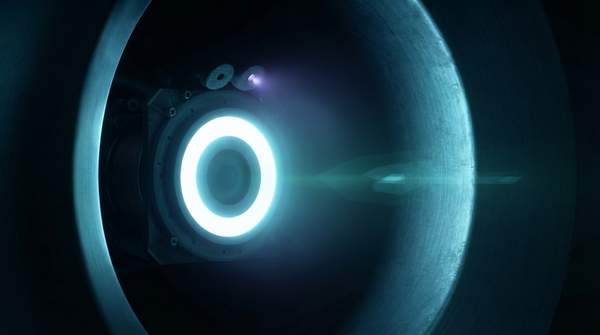
Electric propulsion inverts the equation. These systems convert electrical power into the kinetic energy of the propellant, accelerating it far more efficiently than any chemical reaction can. NASA's survey shows the payoff across every subtype: gridded ion thrusters reach 500–3,000 seconds of specific impulse, Hall-effect thrusters 200–1,920 seconds, electrosprays up to 3,000 seconds, and pulsed plasma and vacuum arc thrusters up to 3,200 seconds.
The price is thrust. Gridded ion systems produce 0.1–20 mN; Hall-effect thrusters 0.25–55 mN; electrosprays just 20 μN–20 mN. These are forces thousands of times smaller than a chemical engine's output, which means electric propulsion requires far longer burn times to achieve the same velocity change. But because high specific impulse minimizes propellant mass, it enables longer mission lifetimes — the reason electric systems dominate station-keeping, precise orbit adjustments, and deep-space cruise phases.
Electric propulsion's effectiveness is tied to available onboard power, which limits its applicability for very rapid maneuvers. The Mars-mission analysis reaches a similar conclusion from the other direction: nuclear-reactor-powered electric propulsion could significantly reduce travel times and propellant needs precisely because it addresses electric propulsion's power constraint.
Propellantless Propulsion: Emerging Options for Niche Applications
The third category abandons onboard propellant entirely. NASA's survey lists solar sails, tethers, electric sails, and aerodynamic drag as propellantless technologies — but marks every thrust and specific impulse entry as "TBD" or absent. That gap is itself informative: these concepts do not fit the thrust-versus-specific-impulse framework at all, because they carry no propellant to measure efficiency against.
Conceptual analyses treat them as theoretical long-horizon options, crediting solar sails and related concepts with potential advantages in thrust and velocity for extended missions while noting that advanced and theoretical systems generally incur higher costs due to technological complexity. For current mission planning, propellantless systems remain niche candidates rather than head-to-head competitors with chemical and electric hardware.
Performance Comparison of Satellite Propulsion Technologies
The table below juxtaposes the ranges from NASA's survey to expose the inverse relationship between thrust and specific impulse. Read across each row: as specific impulse climbs, thrust falls.
| Technology | Thrust Range | Specific Impulse [sec] | Primary Mission Application |
|---|---|---|---|
| Hydrazine monopropellant | 0.25 – 28 N | 180 – 285 | Rapid impulsive maneuvers, orbit insertion, deorbit |
| Alternative mono-/bipropellants | 50 mN – 22 N | 150 – 310 | High-thrust maneuvers where quick velocity changes matter |
| Hybrids | 8 – 222 N | 215 – 300 | High-thrust applications |
| Cold gas | 10 μN – 3.6 N | 40 – 110 | Simple, low-performance attitude and minor adjustments |
| Solid motors | 37 – 461 N | 187 – 269 | Large single impulsive burns |
| Electrothermal | 0.1 mN – 1 N | 20 – 350 | Bridging chemical and electric regimes |
| Electrosprays | 20 μN – 20 mN | 225 – 3,000 | Precise, efficient small-sat adjustments |
| Gridded ion | 0.1 – 20 mN | 500 – 3,000 | Station-keeping, long-duration and deep-space cruise |
| Hall-effect | 0.25 – 55 mN | 200 – 1,920 | Station-keeping, orbit raising over months |
| Pulsed plasma / vacuum arc | 4 – 500 μN | 87 – 3,200 | Fine, efficient micro-adjustments |
| Ambipolar | 0.5 – 17 mN | 400 – 1,100 | Efficient continuous low thrust |
| Solar sails, tethers, electric sails, drag | TBD | – | Niche, propellant-free concepts; metrics not yet characterized |
The pattern is unmistakable: chemical propulsion offers high thrust for rapid maneuvers at the expense of specific impulse, while electric propulsion provides high specific impulse for fuel efficiency over long durations, with lower thrust. No surveyed technology achieves both extremes.
Deciding on Propulsion: Aligning Technology with Mission Goals
When selecting a satellite propulsion system, prioritize either high thrust for rapid, impulsive maneuvers or high specific impulse for long-duration, fuel-efficient operations, based on the mission's primary objectives. A tight maneuver window — an insertion burn, a collision-avoidance sprint, a controlled deorbit — points to chemical hardware. A years-long station-keeping contract or a deep-space cruise points to electric, provided the power budget and timeline can accommodate millinewton-level thrust.
The mission's required delta-V (change in velocity) and the available mission duration will be the primary indicators for the most suitable propulsion class. Work through both numbers before choosing: delta-V sets the total impulse the propulsion system must deliver, and the available duration determines whether a low-thrust, high-efficiency engine can deliver it in time. When the deadline is measured in minutes, the survey's data says chemical; when it is measured in years, electric wins on propellant mass — and propellantless systems remain the option to watch once their performance metrics move from "TBD" to measured fact.