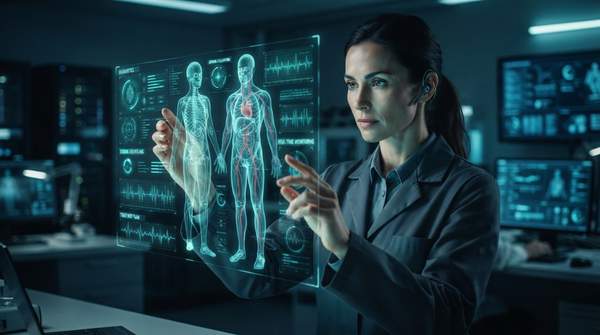
Human Digital Twins (HDTs) are virtual models of patients that leverage real-time data, artificial intelligence (AI), and computational modeling to enhance personalized diagnostics, predictive simulations, and optimized treatment planning in healthcare. This technology creates a dynamic, virtual replica of an individual, allowing clinicians to analyze past and present health processes and anticipate future health trajectories, according to a review in PMC.
The concept, originally introduced for product lifecycle management, has evolved significantly with advancements in technologies like generative AI, cognitive computing, the Internet of Things (IoT), and advanced sensor systems. These developments enable more feasible real-time updates between the physical patient and their virtual counterpart, as noted in npj Digital Medicine.
What are Human Digital Twins in Healthcare?
In healthcare, a human digital twin is an AI-powered virtual patient model that mirrors a physical patient, continuously updated with streams of health data. This "patient-in-silico" evolves alongside its human counterpart, providing clinicians with a detailed, dynamic view of a patient's health, explains Stanford Medicine's Department of Medicine. This virtual representation serves as a tool for simulation, prediction, and optimization in healthcare delivery and medical research.
The core idea behind a digital twin involves a triad: a physical system, its virtual representation, and a bilateral information flow connecting the two, as described in a PMC review. For human digital twins, this means creating virtual persons that advocate for predictive simulation to forecast physiological behavior, treatment responses, and disease tracks, according to a review published in Frontiers by A. Mohan Babu and E. S. Madhan.
Building a Virtual You: Core Components and Data Flow
The creation of a human digital twin is a collaborative process that integrates engineering, AI, and medicine. It begins with defining the physical object or system to be replicated, followed by collecting data from diverse sources to construct a detailed virtual model, as outlined by Amanda Randles of the Duke Center for Computational and Digital Health Innovation. This data collection is foundational to the digital twin's accuracy and utility.
Key data sources include electronic health records (EHRs), medical imaging, genetic profiles, and outputs from wearable devices and other biosensors. These varied inputs provide a holistic view of the patient, encompassing individual characteristics, medical history, and real-time physiological data, according to a PMC article on digital twins for healthcare systems. The continuous streaming of real-time data from IoT devices is particularly important for dynamic updates and predictive capabilities, enabling early detection of potential health issues.
Once data is collected, AI and machine learning algorithms process these vast amounts of patient information. These algorithms are crucial for predictive analytics and generating personalized recommendations, as noted by A. Mohan Babu and E. S. Madhan in Frontiers. Computational modeling then simulates physiological behavior, treatment responses, and disease progression within the virtual twin. This combination of data collection, AI processing, and computational modeling allows the digital twin to function as a dynamic, evolving representation of the patient.
The Human Digital Twin Ecosystem
The following framework illustrates the interconnected components and data flow involved in creating and utilizing a human digital twin in healthcare, from real-world data collection to virtual modeling and practical applications.
| Aspect | Description | Key Technologies | Applications | Challenges |
|---|---|---|---|---|
| Core Concept | An AI-powered virtual patient model that evolves with its human counterpart, providing a dynamic view for personalized care, prediction, and prevention. | AI, Computational Modeling, Real-time Data Integration | Personalized diagnostics, predictive simulation, treatment optimization | Computational intensity, validation criteria |
| Data Collection | Diverse data sources feed the digital twin, including sensor-based monitoring, medical imaging, and electronic health records (EHRs). | Biosensors, Wearable Devices, IoT, EHRs, Medical Imaging, Multi-omics | Real-time patient monitoring, early problem detection, comprehensive patient profiles | Data integration complexity, privacy concerns |
| Virtual Model Creation | AI and machine learning algorithms process patient data for predictive analytics and personalized recommendations, while computational modeling simulates physiological behavior and treatment responses. | Machine Learning, Deep Learning, Computational Physiology, Cloud Computing | Simulating disease progression, predicting treatment outcomes, virtual testing | Model complexity, accuracy vs. utility trade-offs |
| Personalized Diagnostics | Digital twins enable personalized treatment plans by gathering and analyzing patient data from various sources, considering individual characteristics and medical history for tailored care. | AI-driven analytics, Data visualization, Predictive modeling | Accurate diagnoses, individualized risk assessment, early intervention strategies | Data quality, interpretability of AI models |
| Treatment Planning | Digital twins can model tumor growth, predict chemotherapy responses, and test treatment options virtually before real-world decisions, allowing clinicians to optimize strategies and predict patient-specific outcomes. | Simulation software, AI for outcome prediction, Virtual reality (for visualization) | Optimizing drug dosages, surgical planning, predicting side effects, clinical trial design | Lack of consensus on validation, regulatory hurdles |
| Implementation Challenges | The computational intensity required for maintaining updated digital twin models in real-time is a significant barrier, often necessitating trade-offs between model complexity, accuracy, and practical utility. There is also no consensus on reasonable validation criteria for in silico evidence. | High-performance computing, Scalable infrastructure | N/A | Resource constraints, legacy system integration, ethical considerations |
Personalized Diagnostics and Treatment Planning
Human digital twins represent a paradigm shift towards highly individualized treatment approaches in healthcare. By creating patient-specific models that account for unique physiological characteristics and medical histories, these twins integrate multi-omics data, clinical parameters, and lifestyle factors to form comprehensive patient profiles, guiding precision therapeutics and interventions, as detailed in a PMC review. This holistic view allows healthcare providers to make accurate diagnoses and monitor patients in real-time, empowering them to participate actively in their own care, according to a PMC article.
In personalized diagnostics, digital twins enable clinicians to gather and analyze a wealth of patient data from various sources, leading to tailored treatment plans. For instance, the Duke Center for Computational and Digital Health Innovation is pioneering the use of digital twins to diagnose heart conditions and create optimal treatment plans without invasive procedures, by creating personalized digital twins of each patient's blood flow. This capability represents a major leap from reactive to proactive care.
For treatment planning, digital twins offer the ability to test different treatment options virtually before making real-world decisions, as envisioned by Stanford Medicine's Department of Medicine. This can optimize effectiveness while minimizing risks, ultimately improving outcomes and reducing trial-and-error. Specific applications include modeling tumor growth, predicting chemotherapy responses, and simulating treatment cohorts, as highlighted by A. Mohan Babu and E. S. Madhan in Frontiers. This allows for precise treatment planning, particularly for complex conditions like advanced heart failure, where personalized approaches to therapies are crucial.
Challenges and Limitations in Adoption
Despite their potential, the widespread adoption and implementation of human digital twins in clinical workflows face significant challenges. One primary barrier is the computational intensity required to maintain updated digital twin models in real-time, especially for healthcare environments with limited resources, according to a PMC review. These computational demands often necessitate trade-offs between a model's complexity, its accuracy, and its practical utility in clinical settings.
Integrating digital twins into existing healthcare systems also presents considerable complexity. Many healthcare systems operate with legacy technologies that may not readily accommodate the sophisticated infrastructure needed for digital twin implementations, as noted in the PMC review. Beyond technical hurdles, operational and human factors also contribute to the challenge of integrating these advanced tools into daily clinical practice.
Furthermore, a significant limitation lies in the regulatory and validation landscape. There is currently no consensus on reasonable validation criteria for "in silico" evidence—evidence derived from computer simulations—used in human digital twins, according to A. Mohan Babu and E. S. Madhan in Frontiers. While regulatory mechanisms are being developed to bridge the gap between in silico evidence and traditional clinical trials, the lack of established standards remains a hurdle for widespread clinical acceptance and deployment.
Advancing Human Digital Twins in Clinical Practice
Healthcare organizations and researchers should prioritize collaborative efforts to establish standardized validation criteria and improve computational efficiency for real-time human digital twin models. The measurable indicator of progress in this area will be the publication of consensus guidelines for in silico evidence validation.
Sources
- A scoping review of human digital twins in healthcare applications and usage patterns - npj Digital Medicine — Nature
- The Virtual You: How Medical Digital Twins are Revolutionizing Healthcare — Department of Medicine
- Digital Twins in Healthcare — Center for Computational and Digital Health Innovation
- Frontiers | Human digital twins in personalized and predictive healthcare: a comprehensive…